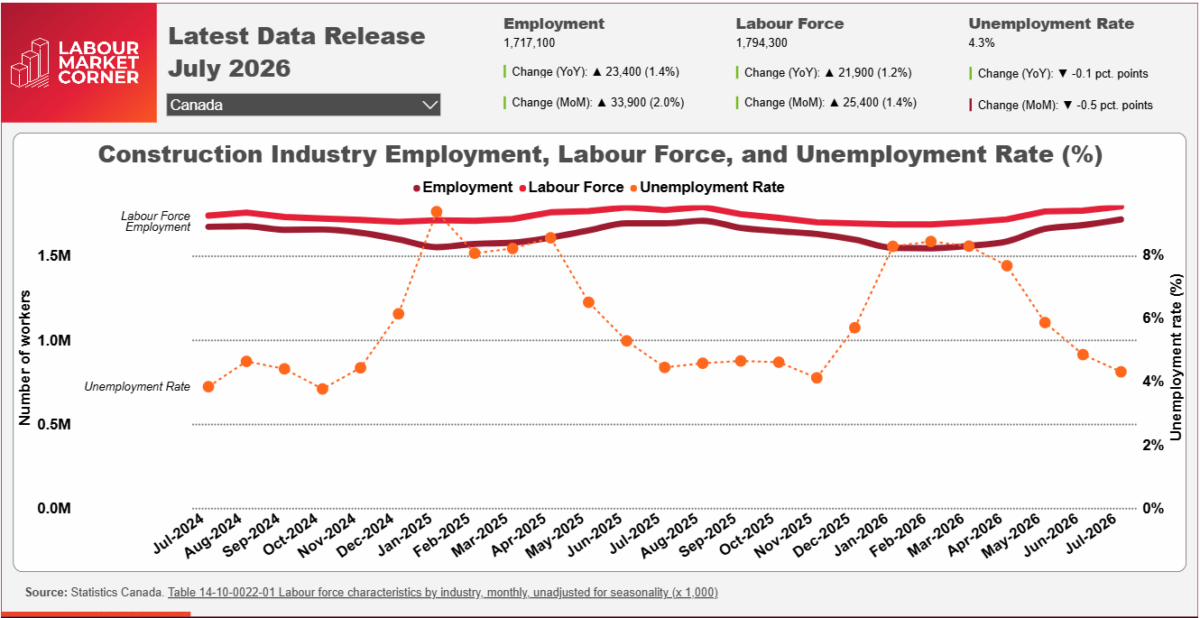
Although construction employment and labour force figures both increased over the 12-month period ending in July 2026, the latest Labour Force Survey data from Statistics Canada reveals a more concerning trend: another notable contraction in the number of women – and young women in particular – in the industry.
Female labour force contracts again as overall unemployment tightens
The data shows an overall increase in construction employment (+1.4%) and in the industry’s labour force (+1.2%) over the past 12 months. These trends combined to edge unemployment down by one-tenth of a percentage point, to 4.3%.
While employment rose notably in the youngest (aged 15 to 24 years) and eldest (aged 55 years and older) male cohorts (+7.9% and +7.2%, respectively), overall employment among women contracted by 3.1%. Driving this change was a contraction of 33.3% in employment among the youngest female cohort. Employment gains among core-aged (25 to 54 years) female workers and the eldest female cohort were modest at 0.3% and 1.9%, respectively – and were not sufficient to offset the significant loss in younger workers.
Additionally, July marked the eighth time in the past nine months in which the female labour force has contracted on a year-over-year basis. Just as with the findings in the June 2026 Labour Force Survey, the group most affected by this trend was the youngest female cohort at -31.8%.
Industrial, institutional buildings construction drives notable growth in western provinces
These changes come at time when the industry is very much in the midst of its busy period. July’s unemployment rate of 4.3% is comparable to those seen in the summer and early autumn of 2025, with five provinces reporting significant employment changes.
Alberta recorded the largest absolute year-over-year gain in employment at +27,300 workers, or +10.5%. British Columbia followed at +19,600 workers (+7.4%), while Manitoba (+8,500 workers; +13.6%) and Saskatchewan (+4,600; +9.1%) also reported notable gains.
Alberta’s employment rise might be attributed to notable growth in industrial building construction. Building permit data for the year ending in June 2026 shows that while the overall value of construction permits is down by 25%, the value of industrial permits has risen by 121%. This is likely due to ongoing activity in support of the light rail transit projects in Calgary and Edmonton.
Data for British Columbia tells a similar story. Although overall permit values are down by just under 6% compared to June 2025, the value of industrial building permits is up more than 234%, and is likely being driven by several major industrial projects in the northern region of the province, including work on several liquefied natural gas facilities and activity related to work on the Millennium Line and Surrey Langley Skytrain projects.
Meanwhile, permit values are notably higher in Manitoba over the same period (+41%), with a huge jump recorded in the value of institutional permits (+854%) that is likely being driven by several significant health care projects underway. The province has also seen increased activity in residential construction. In Saskatchewan, permit values are up 222% over the same 12-month period. This is in part due to a gain of 5,960% in the value of industrial building permits and gains of 162% in multi-dwelling residential building permits and of 86% in commercial-building permits. Ongoing work on BHP’s Jansen Mine continues to drive construction employment in the province alongside a long list of projects in the healthcare sector, and accelerating new-home construction.
Slowing industrial activity contracts employment in Quebec and Ontario
Conversely, construction employment was notably lower in Quebec (-28,100 workers; -8.3%) and Ontario (-7,900 workers; -1.3%). And while growth the industrial sector drove employment increases in Western Canada, Central Canada has seen the opposite effect.
In Quebec, industrial building permit values for the 12-month period ending in June 2026 were down 66%, and are mostly due to project completions in the utilities and transportation sectors.
Ontario’s slowdown is also being driven by a contraction in industrial building permit activity (-25%). As is the case in Quebec, the slowing of work on light rail projects in Ottawa and the Greater Toronto Area may be driving the change – alongside the conclusion of several utility projects across the province.
Three of the four Atlantic provinces reported employment losses of 700 workers or fewer, with only Nova Scotia reporting a gain (+900 workers; +2.0%).
Manitoba construction unemployment rate dips below 2%
Finally, construction unemployment rates for July 2026 varied from lows of 1.7% (Manitoba), 2.6% (British Columbia), 3.2% (Alberta), and 3.8% (Saskatchewan) to highs of 7.3% (New Brunswick) and 13.4% (Newfoundland and Labrador). All other provinces reported rates of 5.1% or lower.
Construction and Maintenance Looking Forward reports for 2026-2035 available now
More information on these and other labour market trends in the construction sector is available in BuildForce Canada’s Construction and Maintenance Looking Forward reports for the residential and non-residential sector. Released on July 20, 2026, the reports are now available for the forecast period of 2026 to 2035.

Construction Key Indicators