New data from Statistics Canada finds a notable contrast in employment among the industry’s youngest and oldest workers over the last 12 months.
The latest Labour Force Survey data from Statistics Canada – for August 2026 – finds modest overall increases in construction’s labour force and employment figures over the past 12 months. Employment rose by 0.8%, or 13,900 workers compared with August 2025 while the labour force added 16,600 workers, or 0.9%. These trends combined to increase the national construction unemployment rate by one-tenth of a percentage point to 4.7%.
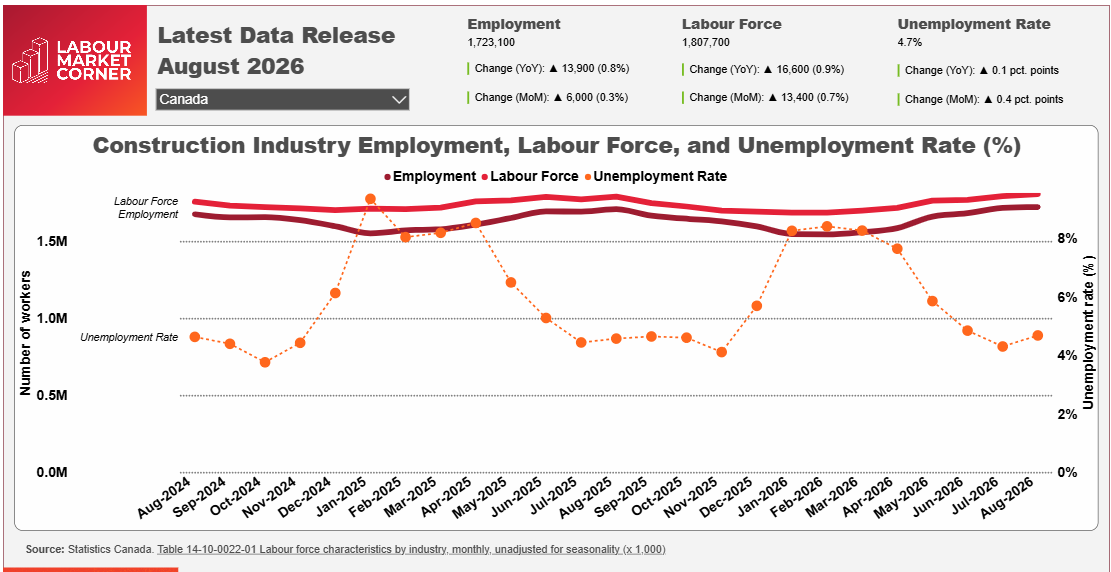
Women, older workers drive national employment growth
A closer look at the data finds that much of the year-over-year employment growth was driven by the female labour cohort. Employment among women grew by 8,600 workers, or 3.9%, compared with an increase of 5,300, or 0.4%, among males. Both cohorts also reported increases in their respective labour forces, at 2.1% and 0.8%.
Also notable was a significant contraction among all young workers over the past 12 months. Employment among those aged 15 to 24 years contracted by 16,700 workers, or 6.8%, while the labour force contracted by 13,200 workers, or 5.1%. Conversely, employment increased among both core-aged workers, i.e., those aged 25 to 54 years (+2,500 workers; +0.2%), and among the eldest working cohort, i.e., those aged 55 years and above (+28,000 workers; +8.9%).
These trends may suggest that older, more experienced workers are returning to the industry to help with project delivery or to fill employment gaps created by labour force contractions among young workers.
Western provinces see notable employment gains
Across the provinces, employment gains were greatest in Alberta (+25,400 workers; +9.7%), Manitoba (+11,400 workers +18.4%), and Saskatchewan (+6,100 workers; +12.2%).
The gain in Alberta is likely due to ongoing infrastructure upgrades at Telus sites across the province, and the start of construction work at Dow Chemicals Path2Zero expansion, the Yellowhead Mainline natural gas pipeline, and the Meta data centre. The province also saw increased levels of new-home construction in August as housing starts rose by 14% compared to a year prior. Employment in Manitoba, meanwhile, appears to be driven by the start of construction on the new biosolids facilities at the North End Wastewater Treatment Plant in Winnipeg. Gains in Saskatchewan can likely be attributed to strength in new-home construction, the start of work on Denison Mines’ Wheeler River uranium project and Saskatchewan Polytechnic’s Saskatoon Campus Renewal project, and ongoing work at the BHP Jansen Mine and the Aspen Power Station.
Activity in Quebec continues to slow from past highs; several major Ontario projects pass peak levels
Employment contractions were greatest in Quebec (-21,700 workers; -6.3%), Ontario (-7,100 workers; 1.2%), and New Brunswick (-1,300 workers; -3.6%).
Compared with a year ago, activity in Quebec has slowed due to changing labour requirements as several major non-residential projects moved passed peak construction activity or toward completion. Although Ontario has benefitted from the start of several major healthcare projects in the past 12 months, overall employment activity has slowed as a number of major projects have passed peak activity periods or concluded. These include the Ontario Power Generation Darlington Refurbishment, the Stellantis and LG Energy electric battery manufacturing facility, and the Gordie Howe International Bridge.
Four provinces report unemployment rates of below 4%
Finally, construction unemployment rates across the provinces varied from a low of 2.8% in Manitoba to a high of 10.7% in Newfoundland and Labrador. Saskatchewan, British Columbia, and Quebec each reported unemployment rates of below 4% for the month, while Ontario, Nova Scotia, Alberta, and New Brunswick reported rates of between 5% and 6%.
Construction and Maintenance Looking Forward reports – available now
For more on these and other construction labour market information trends across the country, see the latest editions of our Construction and Maintenance Looking Forward reports.

Construction Key Indicators