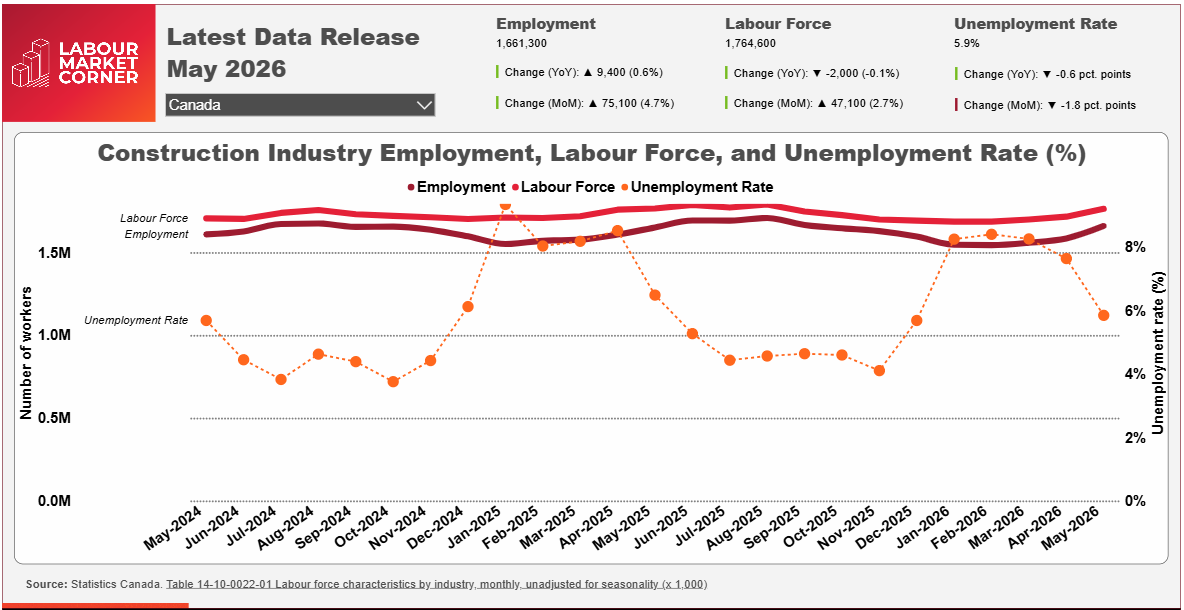
The data finds construction employment up marginally (+9,400 workers; 0.6%) over the past 12 months, while the labour force contracted by 2,200 workers (-0.1%).
The latest Labour Force Survey data from Statistics Canada, for May 2026, finds construction employment up marginally (+9,400 workers; 0.6%) on a year-over-year basis, while the labour force contracted by 2,200 workers (-0.1%). Combined, those trends yielded an industry unemployment rate of 5.9%, as compared to 6.5% from a year ago.
Rising labour demands – a sign that construction season is ramping up – were met by a contraction in the overall number of men and women working or available to work in the construction industry. The decrease was exclusively among men under the age of 54 years old, and among only three provinces: Ontario (-11,000; -1.7%), Alberta (-7,500; -2.6%), and Quebec (-5,700; -1.7%). In Ontario and Quebec, the decline in the labour force led to tightening labour markets in the form of lower unemployment rates; in Alberta the softening of employment outpaced the labour force declines and drove unemployment rates marginally higher.
Year over year gains in employment growth were greatest among workers aged 55 years and over (+11,00 or +3.6%), followed by the working age group of those aged 25 to 54 years (+6,900; +0.6%). Employment growth was weakest among youth and younger Canadians and permanent residents between the ages of 15 to 24 years old (-8,700 workers; -4.3%.).
Overall employment increased among both men (+2,400; +0.2%) and women (+7,000; +3.4%) over the same 12-month period, although a significant contraction (-7,700 workers; -4.2%) was reported among the youngest male cohort as well as among the youngest female cohort (-1,000; -6.0%).
Project startups and completions drive provincial employment variances
Across the country, five provinces reported year-over-year employment contractions. The largest absolute decline was in Alberta at -7,800 workers. Quebec followed at -6,600 workers, with three of the four Atlantic provinces (Nova Scotia, Prince Edward Island, and Newfoundland and Labrador) each reporting losses of 600 or fewer workers.
Among those provinces reporting year-over-year construction employment increases, Ontario led the way with a gain of 9,000 workers. British Columbia followed at +7,000 workers, while Manitoba reported a gain of 5,600 workers. Saskatchewan and New Brunswick recorded more modest gains.
The employment losses in Alberta and Quebec may be directly attributable to slowing construction activity in both provinces. For example, the total value of building permits issued in Alberta for the 12-month period ending in April 2026 finds notable contractions in institutional-building activity (-21%) and residential multiple-dwelling buildings (-26%) and single-dwelling buildings (-11%). Partially offsetting these trends was a significant increase in the value of industrial building permits (+139%). Total permit values are down 8% for the year ending April 2026.
Quebec, meanwhile, reported a notable contraction in the value of institutional building permits at -36%. This decline may be in part driven by anticipated winding down or completion of work at the Fleurimont Hospital, Defence Research and Development Canada Centre, and the National Audit and Collections Centre projects.
Conversely, Ontario has seen notable increases in the value of institutional (+60%) and industrial (+43%) permits over the same 12-month period, while employment increases in British Columbia may be driven by a sizeable gain in the value of industrial permits (+315%).
The growth in Ontario may be partially driven by the anticipated start of several large-scale capital projects including the Ottawa Civic Hospital, the Eglington Crosstown LRT West Extension, the Hamilton Steel Works Direct Reduced Iron Plant Addition, and spin-off activity from the Crawford Nickel project. In British Columbia, the growth in industrial building permit values may be tied work at liquefied natural gas facilities, water treatment facilities, and spin-off activity from major mining projects such as the Red Chris Copper/Gold Mine Expansion, all of which were expected to commence or ramp up in 2026.
Construction unemployment rates across the country for May 2026 varied from a low of 4.1% in Manitoba to a high of 22.2% in Newfoundland and Labrador. The latter was an exception, with all other provinces reporting rates of between 4.8% (Alberta) and 9.7% (Prince Edward Island).

Construction Key Indicators