The data suggest that construction is yet to begin deploying workers ahead of its traditional busy season.
Construction employment and labour force metrics declined marginally for the year ending in March 2026, as reductions were most pronounced among women and older workers; declines were also observed among young workers.
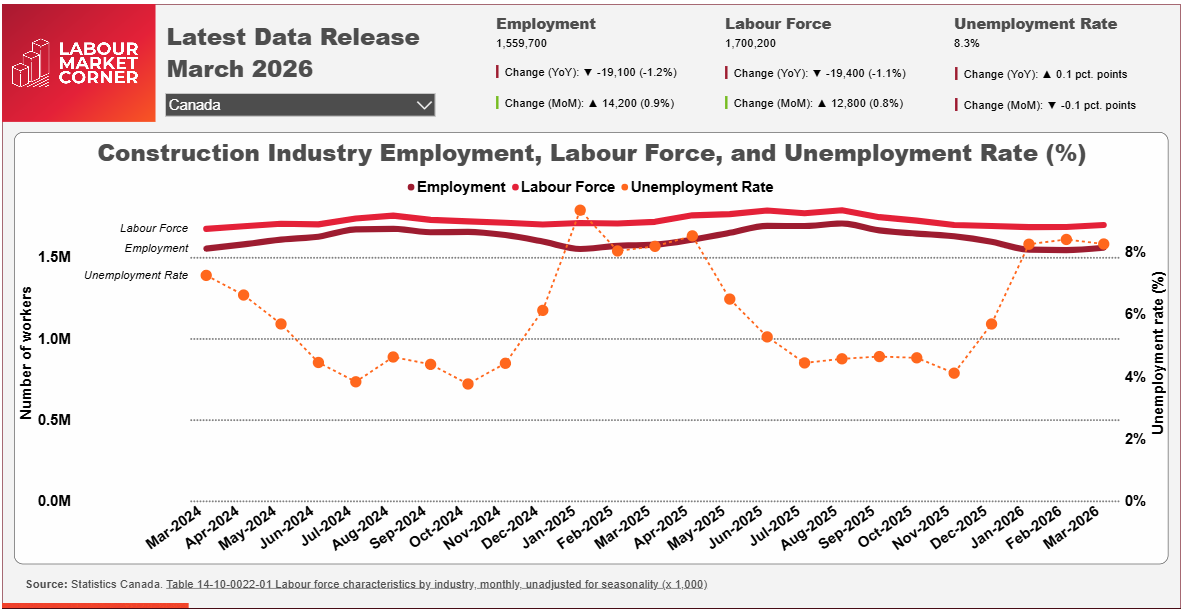
For the past 12 months, construction employment declined by 19,100 workers, or 1.2%, while the industry’s labour force contracted by 19,400 workers, or 1.1%. As a result, construction’s unemployment rate increased by one tenth of a percentage point, to 8.3%.
For the fourth consecutive month, employment losses were greatest among women. At -21,800 workers (-9.9%), this contraction more than offset a marginal gain in employment (+2,700 workers; +0.2%) among men. All three female age cohorts reported reductions of at least 6,500 workers.
Employment among older workers – i.e., those aged 55 years and over – also contracted substantially between March 2025 and March 2026, with a decline of 27,900 workers, or -9.0%. This decline was relatively steeper for women (-17.1%) compared to men (-7.5%). This decline is likely representative of an aging population and retirements, combined with a softer construction market which can accelerate retirement decisions.
Among all youth – i.e., those workers aged 15 to 24 years – employment also contracted notably, with the overall component recording losses of 5,500 workers, or -3.1%. A small gain in employment among young men (+1,000 workers; +0.6%) was more than offset by a decline of 6,500 workers, or -34.8%, among young women. Additionally, a small advancement in core-aged employment among both genders combined (14,300 workers; 1.3%) was insufficient to offset declines among the youngest and oldest age cohorts.
These data continue to suggest that, as of the Labour Force Survey dates in March, construction is yet to begin deploying workers ahead of its traditional busy season. Traditionally, construction employment returns to growth after a winter pause in March or April of each year. Nevertheless, it is worth noting that the construction unemployment rate recorded in March 2026 is very much on par with those rates seen in March of pre-pandemic years – and notably lower than rates seen for the month in the last 10 years.
Across the country, only two provinces – British Columbia and Manitoba – reported notable employment gains in the past 12 months. British Columbia’s sector added 11,400 workers, or 4.5%, compared with March 2025, while Manitoba added 10,100 workers or 18.7%. Saskatchewan, Newfoundland and Labrador, and Nova Scotia also reported more modest gains.
Those provinces recording notable employment declines over the past 12 months included Quebec (-20,300 workers; -6.6%), Alberta (-15,900 workers; -6.0%), and Ontario (-9,300 workers; -1.7%). Combined, the employment losses in these three provinces more than offset gains recorded elsewhere.
Construction activity in Alberta, Quebec, and Ontario, measured by building permit activity for the 12-month period ending in February 2026, may be responding to the adverse effects of the ongoing tariff dispute between Canada and the United States. Construction permit activity in the non-residential sector of all three provinces has declined notably between February 2025 and February 2026, with permit activity in both the industrial and commercial building sectors (i.e., those sectors in which the majority of construction projects are privately funded) in all three provinces down notably over this period. All three provinces are also reporting lower levels of institutional building activity, while Alberta and Ontario continue to see reduced levels of low-rise residential construction.
In contrast, both Manitoba and British Columbia show elevated levels of building permit activity over the year ending in February 2026. Permit values in Manitoba are up by 42% over the previous year, with only activity in commercial building showing reductions over the period. British Columbia tells a similar story, with overall permit values up by 12%.
Finally, the Labour Force Survey data for March 2026 shows provincial unemployment rates varying from a high of 31.3% in Newfoundland and Labrador to a low of 6.0% in British Columbia. Three other provinces – New Brunswick, Nova Scotia, and Quebec – reported rates of 10.0% or more; the remaining provinces reported rates of between 6.3% and 9.2%.

Construction Key Indicators