The most recent Labour Force Survey (LFS) data from Statistics Canada, for June 2026, find both the construction employment and labour force figures lower than the same month a year earlier. Employment dropped by 11,300 workers, or -0.7%, over the previous 12 months, while the labour force contracted by 20,000 workers, or -1.1%. As a result, the national construction unemployment rate dropped by half a percentage point to reach 4.8%.
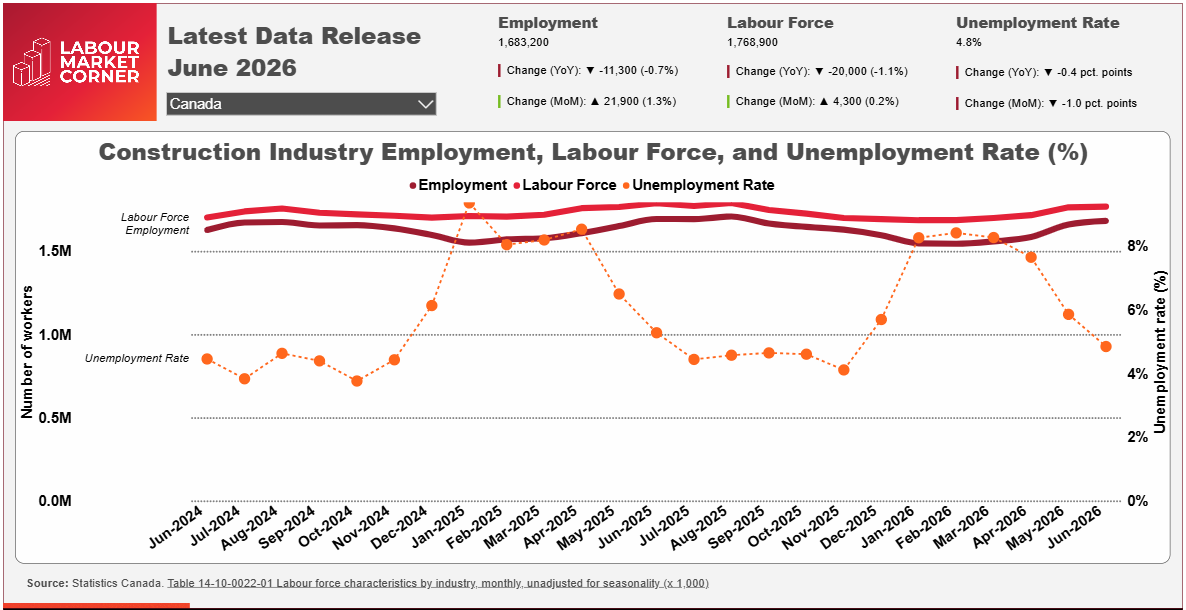
Female labour force contracts for seventh time in the last eight months
The tightening of the unemployment rate in June seems to be tied to a diminishing labour force, rather than expanded demand. In particular, the LFS data shows that the decline in female labour force (-13,300; -5.7%) accounted for about two-thirds of the overall decline. More concerning is the fact that this is the seventh time in the past eight months that the labour force among females has declined. For women, the decline was evident across all age groups, but it was especially strong among the youngest cohort – those aged 15 to 24 years old (-6,100; -26.9%).
Looking more closely, the data show that employment, labour force, and unemployment contracted among both the male and female labour cohorts, with the labour force among men contracting by 6,600 workers, or -0.4%. The labour force decline among male workers was strictly evidenced among the youngest cohort of workers aged 15 to 24 years (-24,000; -11.1%), which was a strong enough decline to offset gains among the core working age group of 25 to 54 years (7,300; 0.7%) and the eldest age cohort of workers 55 years and older (10,100; 3.6%).
The number of workers employed in the construction industry was also lower in June 2026 compared to the same month a year prior. This was the case for both men (-1,800; -0.1%) and women (-9,500; -4.3%).
Building permit, housing start data point to slowing activity among key provinces
One of the reasons behind these employment contractions may be a trend toward slowing construction activity across the country. The most recent national data for building permits and housing starts (i.e., from May 2026) finds that both the value and number of building permits are lower compared to a year previous. Nationally, building permit values were approximately 14% lower, with notable contractions in the value of institutional (-45%) and industrial (-27%) building permits. Activity in the residential sector also appears to have cooled off recently. In May 2026, national housing start figures were approximately 7% lower over the same period last year, with notable contractions in row (-15%) and apartment (-7%) units.
These trends may suggest that workers are exiting the construction labour force due to perceived slowdowns in activity – especially among young workers. Residential construction work in many provinces continues to be impeded by lower levels of immigration, rising rental vacancy rates, and comparatively high purchasing costs. Housing start data for the year ending in May 2026 find notable contractions among several of the more populous provinces, including Ontario (-4%), Quebec (-14%), Alberta (-15%), and British Columbia (-3%). Housing starts also declined in New Brunswick (-17%) and Newfoundland and Labrador (-8%).
Meanwhile, labour force trends in the non-residential sector may be driven by major project completions. Although building permit values are lower in several highly populated provinces, including Alberta (-15%), British Columbia (-1%), Ontario (-19%), and Quebec (-11%), these declines may be short lived. Each of these provinces have a long list of major projects that are either ongoing or scheduled to start in the near future.
Ontario sees significant employment contraction, Manitoba and BC see notable gains
Turning to the labour force trends across the provinces for the year ending June 2026, the data finds a significant contraction in construction employment in Ontario (-26,100 workers; -4.3%). Quebec (-3,500; -1.1%) and Prince Edward Island (-1,000; -9.5%). These losses more than offset employment increases in Manitoba (+6,500; +10.2%), British Columbia (+5,300; +2.0%), and Alberta (+4,200; 1.6%).
The employment contraction in Ontario can be linked to reduced building permit activity over the year ending in May 2026. Within the overall contraction of 19% in permit values over this period, the province saw notable contractions in the values of industrial (-39%) and institutional (-63%) building permits. Declines were particularly acute in the St. Catherines-Niagara, Barrie, Windsor, Brantford, and Belleville-Quite West regions. These are likely due to several key projects in the automotive, manufacturing, and institutional sector passing peak activity periods – or concluding outright. Housing starts in Ontario also remain lower for the 12-month period ending in May 2026.
Conversely, the employment gains reported in Manitoba and British Columbia can be linked to notable building permit growth. Manitoba recorded an increase of 20% over the year ending in May 2026, with notable gains in activity in total building permits, and industrial (+74%) and institutional (+165%) building activity. British Columbia, meanwhile, saw permit activity rise in the industrial (+110%), commercial (+74%), and institutional (+61%) buildings components.
Building permit value increases in the Chilliwack, Kamloops and Kelowna regions offset declines in key areas of the Vancouver Island and Lower Mainland. In Alberta, employment gains are likely driven by major projects activity as preliminary work at the Dow Chemicals Path2Zero expansion and ATCO’s Yellowhead Mainline Natural Gas Pipeline projects – among others were projected to start in 2026. These gains were likely to offset projected declines in the residential sector as new-home construction continued to weaken.
Construction unemployment rates for the year ending in June 2026 varied from a low of 1.9% in Manitoba to a high of 9.7% in Newfoundland and Labrador. Notable among the provinces were rates of 2.2% in Saskatchewan and 3.4% in British Columbia. Most of the remaining provinces reported rates of between 4.9% and 5.9%.
Construction and Maintenance Looking Forward reports for 2026-2035 available now
More information on these and other labour market trends in the construction sector is available in BuildForce Canada’s Construction and Maintenance Looking Forward reports for the residential and non-residential sector. Released on July 20, 2026, the reports are now available for the forecast period of 2026 to 2035.

Construction Key Indicators