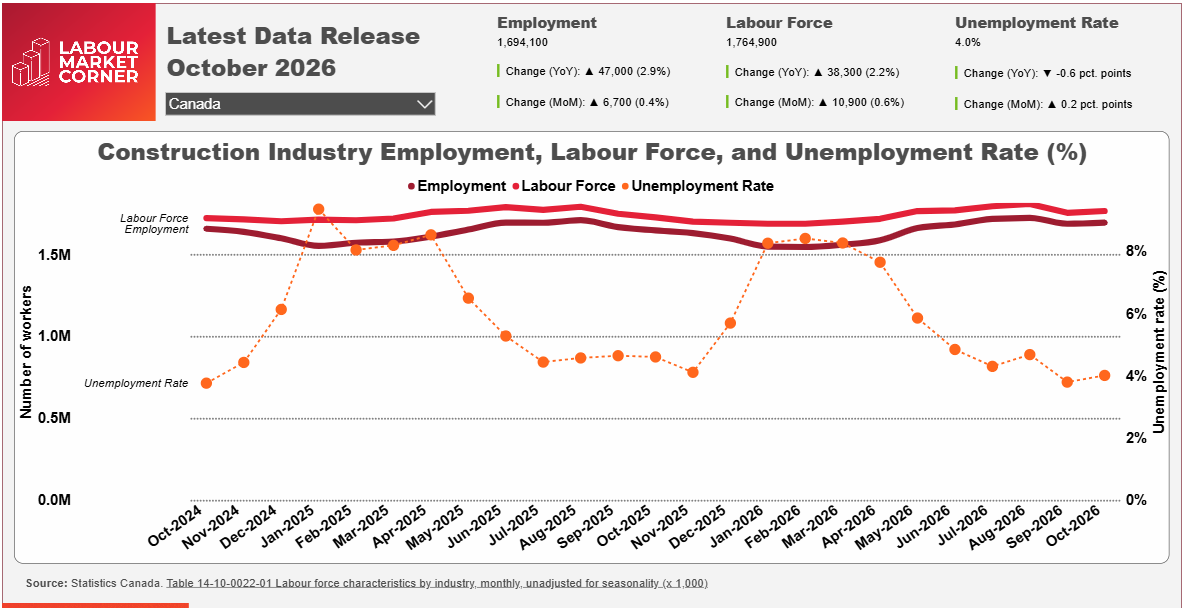
National construction employment increased by 47,000 workers over the past 12 months, while the industry’s unemployment rate declined to 4.0%.
The latest Labour Force Survey data from Statistics Canada, for October 2026, finds year-over-year growth in both construction employment and labour force figures. Employment increased by 47,000 workers, or 2.9%, compared with October 2025, while the labour force added 38,300 workers, or 2.2%. These trends combined to reduce the unemployment rate by 0.6 percentage points to 4.0% on a year-over-year basis.
Employment growth driven by core-aged men and older workers
A closer look at the data finds notable differences in employment trends across age and gender cohorts. Employment among men increased by 51,000 workers (+3.6%) over the past 12 months, offsetting a decline of 4,000 workers (-1.8%) among women. Growth among male workers was concentrated among the core-aged cohort, those aged 25 to 54 years, which added 37,900 workers (+3.9%).
Employment among men and women aged 55 years and older increased by 27,000 workers (+8.6%) compared with October 2025. Growth was particularly notable among women in this age group, whose employment increased by 14,400 workers (+36.3%). Conversely, employment among core-aged women declined by 16,500 workers (-10.4%) over the same period.
Alberta and Ontario led provincial employment gains
In October 2026, seven out of ten Canadian provinces recorded construction employment gains. Among these gains, Alberta (+23,800 workers; +9.3%) and Ontario (+17,600; +3.0%) recorded the greatest absolute employment gains over the past 12 months. Saskatchewan also reported an increase of 5,200 workers (+10.4%), while employment gains of between 800 and 2,800 workers were recorded in Newfoundland and Labrador, Nova Scotia, New Brunswick, and Manitoba.
Alberta’s employment growth comes amid elevated activity on a significant pipeline of major projects. These include light rail developments in Calgary and Edmonton, Dow’s Path2Zero project, the Yellowhead Mainline natural gas pipeline, the Meta data centre, and telecommunications infrastructure upgrades. This activity is supported by building permits, which were up both in value (+2.4%) and in number of permits (+6.8%). The value of permits were up significantly for commercial buildings (+64.8%), with some growth also seen among industrial buildings (+22.5%) and single-dwelling residential units (+4.4%). These gains more than offset declining building permits value for institutional buildings (-40.3%) and multi-dwelling residential units (-29.4%). Building permits activity was particularly strong in Calgary and Lethbridge in September 2026 compared to the same month in 2025.
Ontario’s employment growth was supported by increased value of building permits. The value of permits issued in September was 30.8% higher than in September 2025, with growth across all building types except commercial buildings. Employment activity is also supported by early and core construction work on hospitals in Ottawa, Toronto, and Moosonee, the Scarborough Subway Extension, the Waasigan Transmission Line, and power generation at Darlington.
Employment remains lower in Quebec and British Columbia
Three provinces recorded year-over-year construction employment contractions in October. Prince Edward Island reported a decline of 400 workers (-4.1%) while employment declined by 3,600 workers (-1.1%) in Quebec and by 1,800 workers (-0.7%) in British Columbia.
For Quebec, October marked the 20th consecutive month of construction employment declines with the last month of year-over-year growth in LFS employment credited to February 2025. The decline in October is likely due to retreating new-home construction activity and as several major projects move beyond peak construction or toward completion.
British Columbia’s employment contraction is partly explained by declines in building permits. Permit values were 16.4% lower than in September 2025, with residential permits declining by 21.8% and non-residential permits falling by 9.0%. This slowdown follows the completion or winding down of several major institutional, road, highway, and bridge projects and is consistent with the lower construction employment reported in October.
Six provinces report unemployment rates below 4%
Canada’s construction unemployment rates returned to levels consistent with the 5- and 10-year averages in October.
Manitoba reported the lowest rate at 2.4%, followed by Saskatchewan at 2.8%, Quebec at 3.0%, Prince Edward Island at 3.1%, New Brunswick at 3.3%, and Nova Scotia at 3.6%.
British Columbia’s rate stood at 3.9%, while Alberta and Ontario reported rates of 4.5% and 4.6%, respectively. Newfoundland and Labrador recorded the country’s highest provincial construction unemployment rate at 8.7%.

Construction Key Indicators