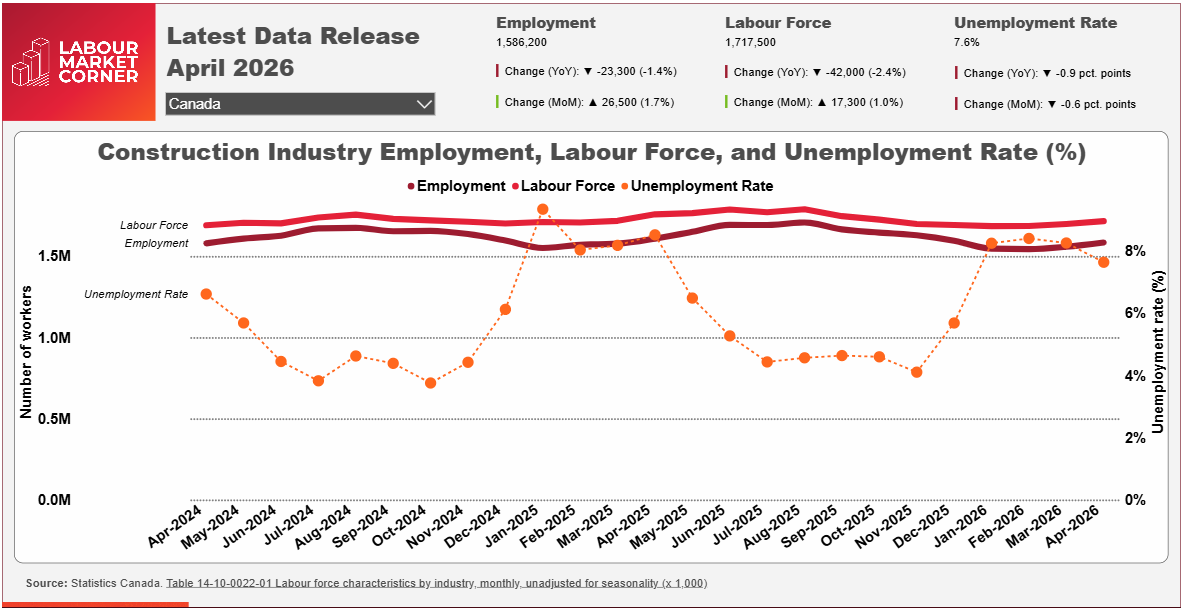
Although the national industry unemployment rate contracted over the year ending in April 2026, the change was principally driven by a decline in the industry’s labour force.
The national construction unemployment rate declined by nearly a percentage point over the 12-month period ending in April 2026 to reach 7.6%. The change was driven by a notable contraction in the overall labour force that outpaced a smaller reduction in employment.
The latest Labour Force Survey data from Statistics Canada finds that over the previous 12 months, construction employment declined by 23,300 workers, or 1.4%, while the industry’s labour force recorded a contraction of 42,000 workers, or 2.4%.
A closer look at the data finds notable reductions in employment among the eldest working cohort (i.e., those workers aged 55 years and over). Employment in that segment contracted by 17,200 workers, or 5.6%, with the largest reductions reported in Quebec (-22%), New Brunswick (-19%), Saskatchewan (-17%), Alberta (-10%), and Ontario (-4%), Also notable was a change among the youngest working cohort, i.e., workers aged 15 to 24 years. Employment among this group declined by 14,000 workers, or 7.9%.
Both groups reported labour force contractions of 7.9% and 10.2%, respectively.
A closer look at construction employment data across the provinces reveals notable trends. Driving the year-over-year employment declines in April 2026 were significant contractions in three provinces. Construction employment in Ontario declined by 8,500 workers, or 1.5%, while Alberta and Quebec recorded contractions of 17,800 workers (-6.6%) and 27,200 workers (-8.5%) respectively.
The decline in Ontario was likely driven by reduced activity in institutional building and winding down of work at the Stellantis electric battery manufacturing facility in Windsor. Building permit values for the 12-month period ending in March 2026 were down 21% among institutional buildings. Alberta, meanwhile, saw a significant reduction (-19%) in overall permit values over the same period, with notable contractions in the value of institutional (-65%) and multi-unit residential (-36%) permits. In Quebec, the decline is likely arising from the wind down of key major projects, such as the Tunnel Louis-Hippolyte-La Fontaine Upgrades, the Hertel-New York Interconnection Transmission Line, and Microsoft’s Data Center projects, all of which are offsetting improvements in other segments of construction, including the residential sector.
In contrast, all other provinces experienced gains in construction employment over the 12-month period ending in April 2026. British Columbia led the way in terms of absolute gains at +13,300 workers, followed by Manitoba (+7,800 workers) and Nova Scotia (+3.600 workers). Manitoba also recorded the most significant relative gain at +13.8%, followed by New Brunswick (+9.6%), and Nova Scotia (+9.1%).
The increase in British Columbia appears to be driven by a gain of more than 51% in overall permit values for the 12-month period ending in March 2026, with an exceptionally large gain reported in the institutional component (+559%) over that period. Manitoba, meanwhile, reported a gain of 68% in permit values over the year ending in March 2026, with a notable increase in three components: industrial buildings (617%), multi-unit residential (+233%), and institutional buildings (+80%). The gain in New Brunswick was underpinned by a large increase in institutional permit values (+135%), while Nova Scotia’s increase was supported by a notable rise in permit values for multi-unit residential buildings (40%).
Finally, construction unemployment rates across the provinces in April 2026 varied from a low of 4.6% in Manitoba to a high of 26.9% in Newfoundland and Labrador. Excluding notably high rates in New Brunswick (13.5%) and Saskatchewan (12.6%), rates among the remaining provinces varied from between approximately 6% and 9%.

Construction Key Indicators