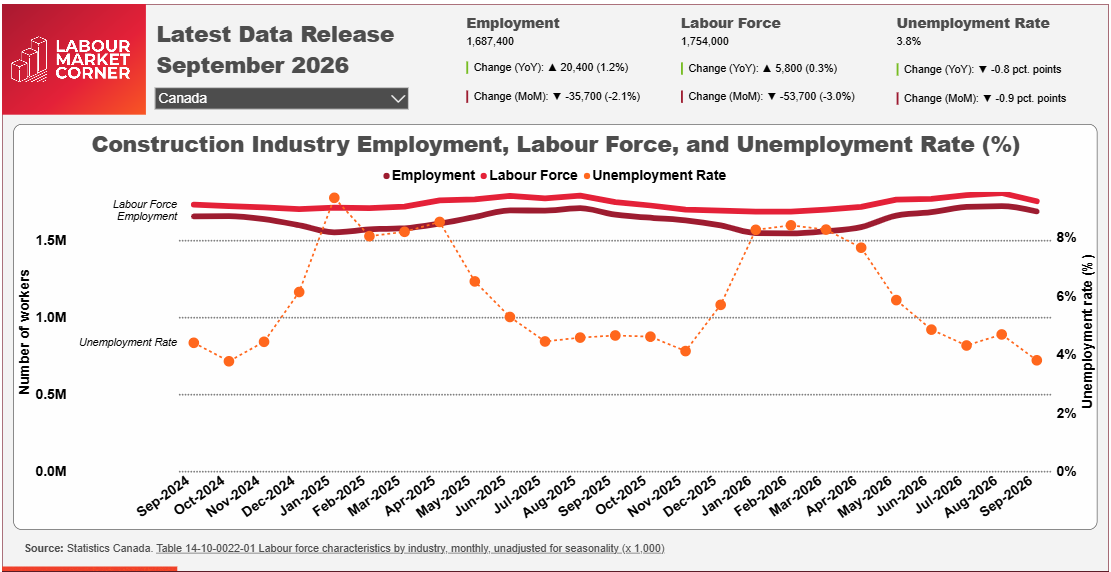
At 3.8%, the national construction unemployment rate reached its lowest level in two years in September. Four provinces reported rates of below 4%.
New Labour Force Survey data from Statistics Canada, for September 2026, finds growth in both construction employment and labour force figures compared with a year ago. The former added 20,400 workers, or 1.2% over the past 12 months, while the latter added 5,800 workers, or 0.3%. As a result, the industry’s unemployment rate contracted to 3.8% – its lowest level since October 2024.
Employment contracts again among young workers
By age cohort, the greatest employment gains over the past 12 months were among core-aged workers, i.e., those aged 25 to 54 years (+17,800 workers; +1.6%) and the eldest cohort, i.e., those aged 55 years and above (+8,400; +2.6%). Partially offsetting those combined increases was a contraction of 5,800 workers, or -2.7%, among workers aged between 15 and 24 years. September marked the second consecutive month – and the sixth month this year – in which year-over-year employment and labour force figures among the youngest working cohort declined in the sector.
Among all workers aged 15 and older, both the male and female cohorts recorded employment increases over the past 12 months, with the former accounting for the majority of the gain at +16,900 workers. That gain was entirely driven by growth among core-aged male workers. Among women, overall employment rose by 3,500 workers, or 1.6%. Meanwhile, the labour force – or those employed and searching for working – declined by 6,500 workers, or 2.8%, driving female unemployment rate down to 2.0% – its lowest level since September 2023.
Eight provinces report employment gains
Across the provinces, Alberta (+17,900; +6.9%) and Ontario (+11,600; +2.0%) recorded the greatest employment gains over the past 12 months. At 5,700 workers each, Saskatchewan and Manitoba also reported notable gains.
Alberta’s employment growth, fueled by building permit activity for the 12-month period ending in August 2026, is being driven by strong overall gains (values are 51.1% higher compared with August 2025), and gains in particular in the value of industrial buildings (+737.5%), commercial buildings (+99.8%), and multi-unit residential buildings (+85.5%). Several multi-billion-dollar projects in the province, including light rail lines in Calgary and Edmonton, Dow Chemicals Path2Zero expansion, the Yellowhead Pipeline, Air Products’ net zero hydrogen energy complex, the Meta data centre, and Telus infrastructure upgrades have either recently started construction or are approaching peak activity periods.
In Ontario, employment gains are being driven by early or core construction work on hospitals in Ottawa, Toronto, and Moosonee, ongoing work on the Scarborough subway extension in the Greater Toronto Area, activity on the Waasigan transmission line in the northwestern region, and work on the small modular reactor project in Darlington.
Only two provinces – Quebec (-15,800 workers; -4.7%) and British Columbia (-8,300; -3.1%) – recorded employment losses since September 2025. Over the past 12 months for the period ending in August 2026, British Columbia has seen notable declines among overall building permit values (-19.0%), and in commercial building (-52.9%) and institutional building (-34.1%) activity. The contraction in the latter is likely due to the conclusion of work on major hospital projects in Burnaby and New Westminster. Several notable roads, highways, and bridges projects also reached conclusion in the province in the third and fourth quarters of 2025.
Quebec, meanwhile, continues to show the effects of a slowing construction market in comparison to elevated levels reported a year ago. Although several major non-residential projects moved past peak construction activity or toward completion over this period, the province is beginning to show elevated levels of building permit activity among the industrial and institutional buildings components for the year ending in August 2026.
Four provinces report unemployment rates of below 4%
Finally, five provinces (Quebec, Manitoba, Alberta, Nova Scotia, and Prince Edward Island) recorded unemployment rates of below 4% in September 2026, with Quebec reporting the lowest rate at 2.1%. Newfoundland and Labrador reported the country’s highest provincial rate of 8.4%.

Construction Key Indicators