A year-over-year contraction of -14.4% (-50,600 workers) among the eldest labour force cohort may suggest workers are exiting the industry due to retirement or other age-related attrition.
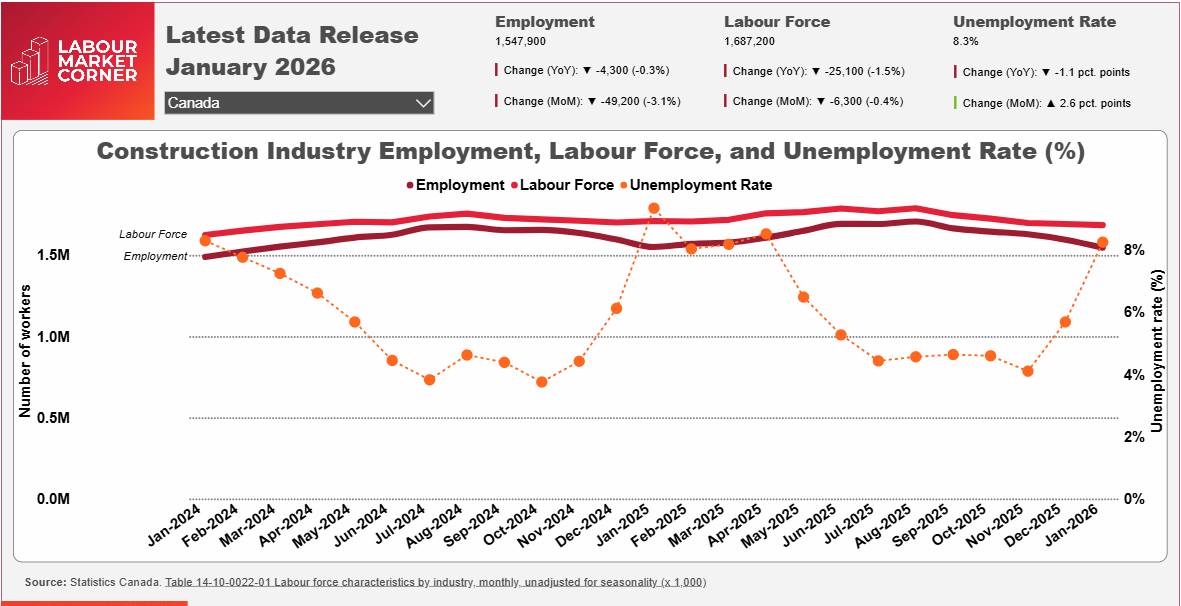
For the 12-month period ending in January 2026, construction’s labour force and employment metrics both declined.
The contraction of 25,100 workers, or -1.5%, in the labour force was notably more significant than the contraction of 4,300 workers, or -0.3%, in employment. As a result, the year-over-year unemployment rate declined by a full percentage point – from 9.3% to 8.3%.
While trends can vary month-to-month, the January 2026 Labour Force Survey suggests the declines in the labour force are likely driven by age-related attrition.
Overall employment losses in the past 12 months were exclusive to the eldest cohort, i.e., those aged 55 years and over. The labour force in that cohort contracted by -14.4% (-50,600 workers), which may suggest workers are exiting the industry due to retirement or other age-related attrition.
Meanwhile, the labour force young workers, i.e., those aged 15 to 24 years, rose by 4,500 workers (+2.3%) and the labour force among core-aged workers, i.e., those aged 25 to 54 years, increased by 20,900 workers (+1.8%). These gains only partially offset the attrition of the eldest cohort.
The labour force contraction was also almost exclusively among women – with a labour force decline of 24,400 workers (-10.6%) compared to a decline of 700 workers among men. Moreover, the contraction among women spanned all age cohorts although an attrition trend has emerged among the eldest cohort where the labour force has declined, year-over-year, for the past 11 months.
Five provinces reported employment increases over the year ending in January 2026. British Columbia led the way with the greatest absolute increase of 13,700 workers, or 5.4%. Manitoba followed with an increase of 4,600 workers (+8.6), while Nova Scotia, Saskatchewan and New Brunswick counted increases of between 1,400 and 700 workers.
Although the value of building permits issued in British Columbia for the year ending December 2025 was down by 4.4% compared to a year previous, the province has seen a significant increase in the value of permits issued for institutional-building projects (+124.8%). Over this period, the province has seen the start of construction on several major healthcare projects, including cancer centres in Nanaimo and Kamloops, and the Burnaby Hospital Renewal. Also contributing to the growth was 5.9% increase in housing starts across the province.
Meanwhile, four provinces reported employment contractions over the past 12 months. Quebec reported the greatest absolute and relative contractions at -14,500 workers and -4.7%. Although building permit values at the close of 2025 were approximately 2% higher than at the end of 2024, Quebec experienced notable slowdowns in the volume of industrial and commercial building projects last year. These, combined with the conclusion of several other large-value projects, are likely responsible for contracting employment.
Ontario followed with contraction of -8,700 workers (-1.6%), while Alberta saw a decrease of -1,900 workers (-0.8%). Newfoundland and Labrador reported a contraction of -500 workers, while employment in Prince Edward Island was unchanged.
Provincial unemployment rates varied, with four provinces reporting rates of 10% or more. Newfoundland and Labrador reported the largest rate among those at 26.9%, while New Brunswick reported a rate of 18.1%. Manitoba (10.6%) and Quebec (10.0%) followed. Rates among the remaining provinces varied from a high of 8.1% in Saskatchewan to a low of 6.4% in British Columbia.

Construction Key Indicators