Statistics Canada’s Labour Force Survey data for the month finds notable year-over-year labour force and employment contractions among two groups: all women, and all workers aged 55 years and above.
Construction’s key employment indicators declined notably for the 12-month period ending in February 2026. Compared with February 2025, employment retreated by 26,100 workers while the labour force’s decline was more moderate at 21,600 workers. As a result, construction’s unemployment rate rose to 8.4%.
While trends can vary month-to-month, the data from Statistics Canada’s Labour Force Survey – for February 2026 – suggests the declines in the labour force are likely driven by age-related attrition.
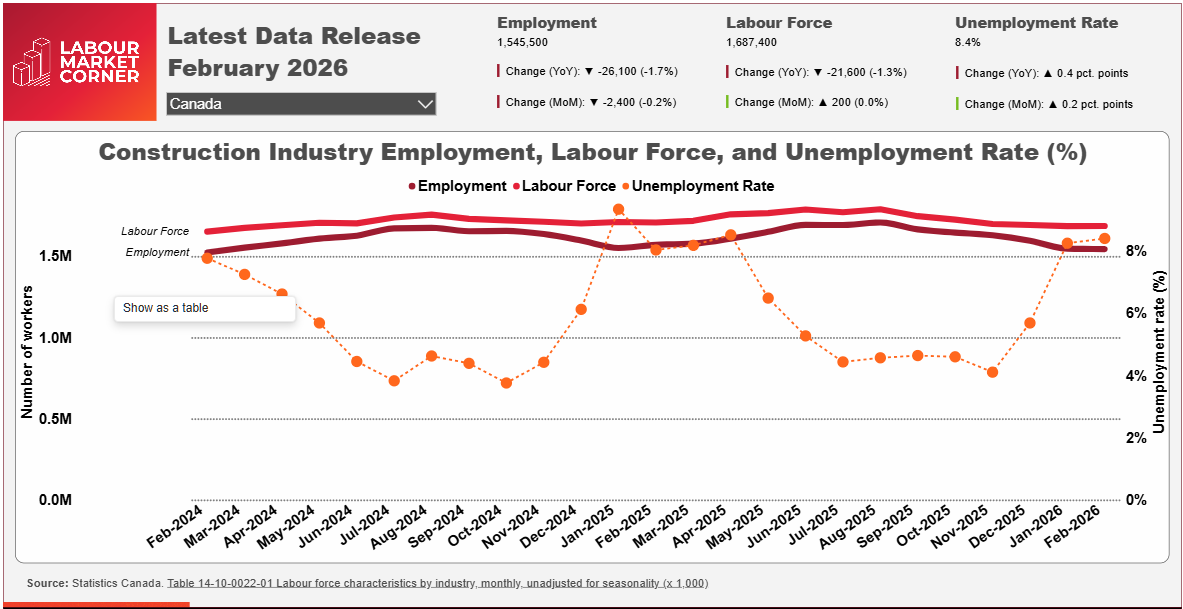
February’s data finds notable contractions among two groups. The number of employed workers in the eldest age cohort, i.e., those aged 55 years and over, contracted by 43,300, or 13.9% while the number in the labour force contracted by 38,300, or 11.4%. This fact suggests that more workers may be exiting the industry due to retirement or age-related attrition.
Meanwhile, employment among women contracted across all age cohorts, for an overall decline of 26,900 workers, or -12.4%. The female labour force also contracted by 24,200 workers, or -10.6%. Among women, the greatest employment contraction (-17,400 workers, or 11.2%) was reported among core-aged workers (i.e., those aged 25 to 54 years). With a decline of -5,100 workers, or -10.3%, the eldest female labour force cohort has now declined, year over year, in each of the past 12 months.
Employment among all men, in contrast, rose by 800 workers, or 0.1%. Gains among the youngest male cohort (i.e., those aged 15 to 24 years) and among core-aged male workers more than offset a contraction of 35,400 (-13.3%) among the eldest male cohort.
Only four provinces reported employment increases over the past 12 months. British Columbia led the way with an increase of 8,800 workers, or 3.5%. Manitoba and Saskatchewan followed suit with gains of 6,100 workers (+11.1%) and 3,000 workers (+7.0%) respectively.
The increase in employment in British Columbia is likely being driven by a large number of major projects underway across the province, including in the education, healthcare, transportation and utility sectors. The province is also seeing a strong pickup in new-home construction, particularly among apartments and other multi-family units.
The gains in Manitoba, meanwhile, are being driven by a rise in residential construction activity, as measured by gains in building permit values for both single-detached and multi-unit dwellings in the province for the year ending January 2026. Housing starts were also up 126% in February 2026 compared to the same month a year prior.
Saskatchewan, too, has seen a significant increase in the value of building permits issued for multi-unit dwellings over the 12-month period ending in January 2026. For February 2026, housing starts among apartment buildings was up more than 400% compared to February 2025, with increases also seen among single-detached units. The province has also seen notable gains in permit values for commercial and institutional building types.
Meanwhile, three provinces reported year-over-year employment declines of more than 12,000 workers. Quebec reported the greatest absolute employment decline at -15,300 workers, or -5.0%. The decline was likely a result of several large-scale projects passing peak levels of activity or reaching completion. Ontario reported a decline of -13,400 workers, or -2.4%, despite a modest uptick in the construction of apartment buildings, and Alberta recorded declines of -12,200 workers and -4.7%, in part due to a downturn in new-home construction.
Construction employment in Ontario continues to be hampered by a sluggish residential sector, despite a modest increase in apartment housing starts. Building permit values for the construction of single-detached and multi-unit dwellings both declined for the 12-month period ending in January 2026. Permit values for residential construction projects are 13% lower, province-wide with notable contractions in such census metropolitan area (CMAs) as Toronto (-20%), Barrie (-88%), Peterborough (-88%), Kingston (-85%), and London (-75%).
Alberta, too, is seeing lower values for residential building permits for the year ending in January 2026. Values are down 15% overall across the province, with contractions reported across all four CMAs, including drops of 50% in Red Deer, 19% in Edmonton, 11% in Calgary, and 7% in Lethbridge. Meanwhile, the province has seen a year-over-year gain of more than 440% in permit values in the institutional sector, likely driven by work on key projects such as phase one of the Red Deer Hospital Expansion and ongoing work at the 4 Wing Cold Lake Military Fighter Squadron Facility.
Construction unemployment rates varied across the provinces from highs of 25.0% in Newfoundland and Labrador and 16.8% in New Brunswick to a low of 5.6% in British Columbia. Most other provinces reported rates of between 6.6% (Prince Edward Island) and 9.8% (Nova Scotia).

Construction Key Indicators